Tuesday, 28 August 2012

Thursday, 16 August 2012
The Colour Wheel of Emotion
 The pitfalls of depression have now been labelled with its own colour; the
shade of grey to be exact. This to us screams connotations of extreme
gloominess and misery, and it seems people who suffer from anxiety or
depression agree, as when asked to pick a colour out of several, their first
inclination was to choose grey. Colours are often used metaphorically in
literature to convey emotion, such as the classic ‘I was feeling a bit blue’. However,
there is now scientific interest linked to our colour preferences. Recent
research
suggests that colours can provide an insight into how we see ourselves,
while allowing us to express our emotions more effectively than we would with
verbal communication.
The pitfalls of depression have now been labelled with its own colour; the
shade of grey to be exact. This to us screams connotations of extreme
gloominess and misery, and it seems people who suffer from anxiety or
depression agree, as when asked to pick a colour out of several, their first
inclination was to choose grey. Colours are often used metaphorically in
literature to convey emotion, such as the classic ‘I was feeling a bit blue’. However,
there is now scientific interest linked to our colour preferences. Recent
research
suggests that colours can provide an insight into how we see ourselves,
while allowing us to express our emotions more effectively than we would with
verbal communication.
Professor of Medicine and Gastroenterology Peter Whorwell of the
University Hospital in South Manchester says that ‘colours are frequently used
to describe emotions such as being green with envy and in the blues’. Whorwell
and a team of researchers created a colour wheel of eight colours: red, orange,
yellow, green, blue, purple, pink and brown and then broke them down into four
shades of each. They then added black, white and four shades of grey.
Next they recruited 105
healthy adults, 110 anxious adults and 108 depressed adult. The wheel was
produced to indicate people’s preferred pigment in accordance to their relative
state of mind. The participants were then asked
to pick their favourite colour, the colour they were most “drawn to,” and the
colour that described their day-to-day mood based over the last several months.
Whether depressed, anxious or healthy,
people’s favourite colour was blue and they were most drawn to yellow. However
when it came to mood, the groups diverged. The group of people, who were neither
anxious nor depressed, clinically speaking, picked yellow to represent their
mood; while the anxious/depressed among them preferred grey. According to the
researchers, the colour grey implies "a dark state of mind, and a
colourless monotonous disinterest in life." However yellow is associated
with "happiness, cheerfulness and a positive emotional state."
Whorwell
and others are hoping that the colour wheel can be used in the medical field to assess health
status/mood and to diagnose depression. The technique may be beneficial in
circumstances where the participants cannot effectively communicate verbally,
such as withdrawn children, people with communication
problems or those of whom English is not their first language.
Thursday, 12 July 2012
Robert M. Sapolsky
“I love science, and it pains me to think that so many are terrified of the subject or feel that choosing science means you cannot also choose compassion, or the arts, or be awed by nature. Science is not meant to cure us of mystery, but to reinvent and reinvigorate it.”
Thursday, 21 June 2012
Retinal Ganglion Cells
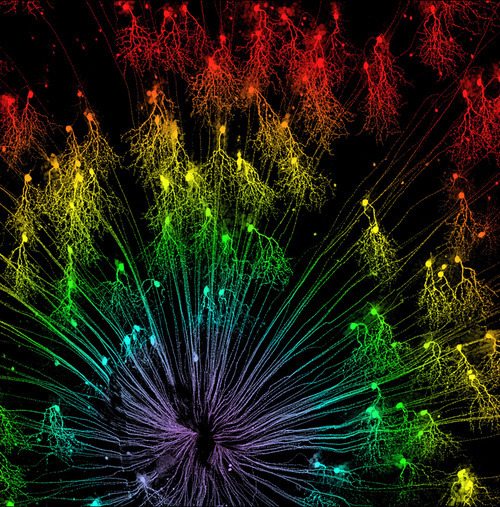
Retinal ganglion cells (RGCs) are neurons that relay signals from therods and cones in the eye to several regions of the brain. This image is of a mouse retina, here the RGCs “point” to a single direction producing this beautiful image.
Saturday, 3 March 2012
David Attenborough: What A Wonderful World
Okay, so...I have a very unhealthy obsession with Sir David Attenborough...
David + Wonderful World = very happy me! <3
Monday, 9 May 2011
The Advantage Of Fever
When we feel ourselves burning up, we reach for the painkillers, dab
ourselves with a cold flannel, and do whatever means necessary to cool
ourselves down. In doing this we may be adding fuel to the fire, as it
has been said that fever or 'pyrexia' as it is otherwise known may
facilitate the survival of many organisms and that it is nature’s way of
healing itself.
Pyrexia is an essential defense mechanism which occurs when the body is invaded by microorganisms and other noxious stimuli. The importance of this mechanism has been demonstrated with the desert Iguna (Dipsosaurus dorsalis) where the administration of antipyretics resulted in the death of the animal after the injection of various reptilian pathogens. Additional findings have shown that exposure to hyperthermia in vitro will generally reduce the growth of many microorganisms. Thus suggesting that the prevention of pyrexia alters the hosts defence mechanism, and hence fever or hyperthermia may provide a natural remedy to infection.
In the past, before antibiotics were produced, fever therapy was the principal form of treatment for syphilis, gonococcal infections and chancroid. Consequently it has been suggested that fever therapy which is a remedy that involves inducing abnormally high body temperature may be a promising treatment for cancer, and that reverting back to primitive remedies may be extremely beneficial.
Pyrexia is an essential defense mechanism which occurs when the body is invaded by microorganisms and other noxious stimuli. The importance of this mechanism has been demonstrated with the desert Iguna (Dipsosaurus dorsalis) where the administration of antipyretics resulted in the death of the animal after the injection of various reptilian pathogens. Additional findings have shown that exposure to hyperthermia in vitro will generally reduce the growth of many microorganisms. Thus suggesting that the prevention of pyrexia alters the hosts defence mechanism, and hence fever or hyperthermia may provide a natural remedy to infection.
In the past, before antibiotics were produced, fever therapy was the principal form of treatment for syphilis, gonococcal infections and chancroid. Consequently it has been suggested that fever therapy which is a remedy that involves inducing abnormally high body temperature may be a promising treatment for cancer, and that reverting back to primitive remedies may be extremely beneficial.
Sunday, 8 May 2011
Saturday, 26 February 2011
Reason for why the brain is my favourite organ
The human brain is an incredible
machine that produces our every movement, conjures up our emotions, and allows
us to pave the way in which we perceive and experience the world. The extreme complexity of the millions
of connections between the cells within the brain, and their profound processes
is what makes the brain unique. Processes within the brain allow connections
between different circumstances that we have encountered in our everyday lives,
thus producing a journey of events that can be recalled upon. A phenomenon
known as synaptic plasticity occurs within the brain to strengthen the
connections that are stored, thus moulding the habits that have been learnt by
reinforcing certain patterns of brain activity.
Tuesday, 22 February 2011
Subscribe to:
Posts (Atom)